Best Drain Cleaning Tools 2026: What a Drain Tech Actually Uses
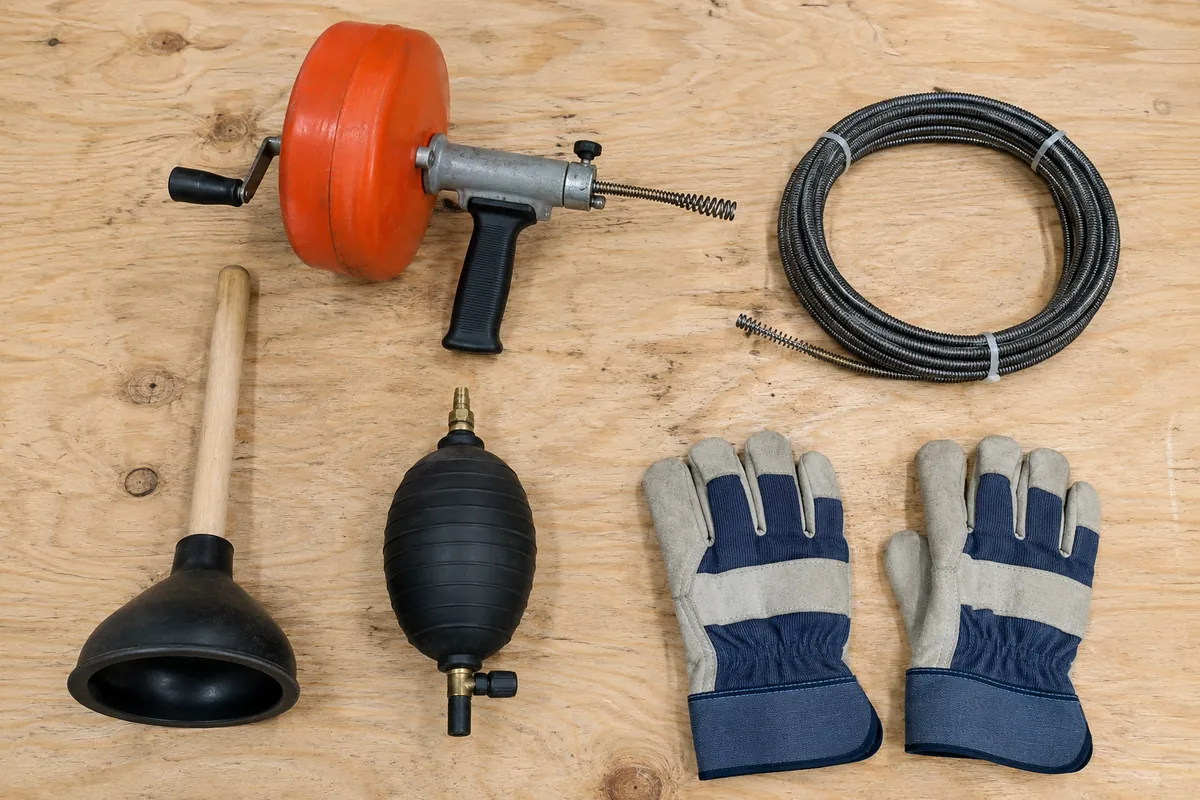
Best drain cleaning tools: for a homeowner, a $25 hand auger and a $5 plastic hair tool clear roughly 80 percent of clogs you'll ever see, and the rest belong to a tech with a power machine and a camera.
I've been clearing drains for fifteen years, residential and commercial, with everything from a bent coat hanger to a trailer-mounted jetter. I've watched homeowners pour money into the wrong tool because a hardware store endcap told them to. So this is the honest version. I'll tell you what to buy, what to rent, and the exact moment you should put the tool down and call somebody with a truck.
If you want the step-by-step for an actual clog, read my guide on how to unclog a drain next. This article is about the tools themselves.
How I Think About Drain Tools
Every clog has a personality. Hair and soap scum behave nothing like kitchen grease, and neither one behaves like a root mass forty feet down a sewer line. The mistake I see constantly is buying one tool and expecting it to do everything. A coat hanger that snags a hair clog in a shower will do absolutely nothing against grease packed in a 2-inch kitchen branch.
So I sort tools by the job, not by the price:
- Surface clogs (the trap, the first couple feet): hand tools win.
- Branch line clogs (3 to 25 feet of pipe): hand auger or a drill-driven drum auger.
- Main line clogs (the big horizontal run to the street): power machine or jetter, and usually a pro.
Match the tool to where the clog actually sits and you stop wasting money.
Hand Augers (The First Real Tool)
A hand auger, also called a drum snake or a hand spinner, is the tool I'd put in every homeowner's garage. It's a coiled cable in a drum with a hand crank. You feed the cable into the drain, crank to push it through the trap and into the pipe, and either break the clog up or hook it and pull it back.
For most sinks and tubs, a 25-foot, quarter-inch cable is plenty. Get the version with an actual drum, not the cheap open-reel coil that turns your hands black and kinks the second you hit resistance. The Ridgid hand auger and the Cobra drum auger are both solid for under fifty bucks and will outlast every gimmick on the shelf.
One thing nobody tells you: technique matters more than the tool. Keep tension on the cable, let it spin, and never force it around the trap. If you jam it, you'll just coil the cable up behind the clog and feel nothing.
Drill-Driven Drum Augers
This is the upgrade most homeowners skip and shouldn't. A drum auger that chucks into a standard cordless drill gives you real torque without buying a $400 machine. You get the cable spinning fast enough to actually chew through soap and light grease, and you're not cranking your forearm raw.
The drill-powered drum auger options run 25 to 50 feet. For a homeowner with a recurring tub or bathroom-sink clog, this is the sweet spot: more power than a hand crank, none of the danger and bulk of a sectional machine. Just wear gloves and eye protection, because anything spinning at drill speed will fling gunk.
Why Flat-Tape "Snakes" Fail on Hair
Walk into any big-box store and you'll find a flat, ribbon-style plastic or metal "snake" sold as a drain tool. I'll save you the money: these are nearly useless on hair.
Here's the physics. Hair clogs are soft, springy, and woven around the cross-bars of the drain. A flat tape has no head, no barbs, and no rotation. It pushes straight into the hair mass and either slides past it or compacts it tighter. What actually grabs hair is a barbed tool or a spinning coil that can twist into the mass and pull it back out in one nasty rope.
So skip the flat tape. For hair specifically, the right tool costs five dollars.
Zip-It Style Hair Tools
The single best dollar-per-clog value in this entire article is the disposable barbed hair tool. It's a long plastic strip covered in backward-facing barbs. You push it down the drain, the barbs slide past the hair on the way in, then snag the whole mat on the way out. I've pulled clumps the size of a small animal out of bathroom drains with one of these.
Grab a Zip-It drain hair tool or a reusable stainless version. Keep a pack under the sink. Used monthly on a tub that two long-haired people share, it'll prevent half the clogs you'd otherwise call me about. For the full fixture-by-fixture method, my unclog a drain guide walks through it.
Closet (Toilet) Augers
Do not put a regular drum snake down a toilet. The bare cable will scratch and chip the porcelain bowl, and a chipped bowl is a new toilet. Toilets get their own tool: a closet auger, sometimes called a toilet auger.
A closet auger has a rubber boot or sleeve that protects the porcelain and a curved guide tube that aims the cable straight into the trap-way where toilet clogs actually live. You crank, the cable spins into the trap, and it either breaks up the clog or hooks whatever a kid flushed down there.
The Ridgid closet auger is the one I keep on the truck. Three feet of reach handles the vast majority of toilet clogs. If a closet auger and a good flange plunger both fail, the clog is usually past the toilet and into the branch line, which is a different job.
Power Drain Machines (Ridgid K-Series)
Now we're into pro territory. A sectional or drum power machine like the Ridgid K-400 or the bigger K-series spins a thick cable with a motor, with enough torque to drive 50 to 100 feet of cable through a main line and tear through roots. This is the tool that clears the clog a hand auger can't touch.
Here's my honest take for homeowners: you can rent these, and for a one-time main-line clog a rental is reasonable. But these machines are genuinely dangerous if you don't know what you're doing. The cable can kink, snap back, or grab a glove and break your wrist or worse. I've seen the aftermath. If you rent a Ridgid K-400 drain machine, wear the gauntlet gloves, never wrap the cable around your hand, and keep the foot pedal control where you can kill it instantly.
| Tool | Typical reach | Best for | Homeowner-friendly? |
|---|---|---|---|
| Zip-It hair tool | 1.5 ft | Tub/shower hair | Yes, very |
| Hand auger | 25 ft | Sinks, tubs, branch lines | Yes |
| Drill-driven drum auger | 25 to 50 ft | Tougher branch clogs | Yes, with care |
| Closet auger | 3 ft | Toilets only | Yes |
| Power machine (K-series) | 50 to 100 ft | Main lines, roots | Rental only, with caution |
| Hydro jetter | Full line | Grease, recurring, commercial | No, pro only |
Where Homeowners Should Stop
This is the part the tool sellers won't tell you. There's a hard line where DIY stops being smart.
Stop and call a pro when:
- More than one fixture backs up at once. If you flush the toilet and the tub gurgles or fills, the clog is in the main line, not the fixture. No hand tool reaches it. This is the single clearest sign you've got a main-line problem, and I cover the rest in signs your sewer line is clogged.
- You've run a cable and it keeps coming back in days or weeks. Recurring clogs usually mean grease buildup, a belly in the pipe, or roots. A cable pokes a hole through it. It doesn't clean the pipe wall. That's a job for hydro jetting versus snaking.
- You hit a hard stop at the same depth every time. That's often roots or a collapsed section, and you want a camera in there before anyone keeps cabling blind.
Knowing when to stop is the difference between a $25 fix and a $4,000 one. There's no shame in it. I make my living on the clogs homeowners can't reach.
Enzyme Maintenance vs Caustic Chemicals (The Honest Version)
Let me be blunt about the bottle of caustic drain cleaner under your sink. Those products, the lye and sulfuric-acid types, generate heat and can soften PVC, corrode older metal pipe, and damage rubber gaskets and seals. The Consumer Product Safety Commission treats these as corrosive household hazards for a reason: a splashback can blind you or burn skin. They're a stopgap, not a fix. They might melt a path through a soft clog, but they leave the buildup on the pipe wall and they sit there as a hazard for the next person (me) who opens that drain. I've taken a face full of caustic backsplash from a trap somebody dosed an hour earlier. I do not love these products.
For maintenance, enzyme and bacterial cleaners are the smarter play. They don't blast a clog open, so don't expect overnight miracles. What they do is slowly digest the organic film, grease, hair, and soap that builds on pipe walls, and they won't hurt your pipes or your septic system. If you're on a septic tank, the EPA's septic guidance is worth a read, because caustic cleaners can kill off the bacteria your tank depends on, while enzymes don't. Used monthly on a slow-but-not-clogged drain, a product like Green Gobbler enzyme drain cleaner or a bio-enzyme drain maintenance treatment keeps lines flowing without the collateral damage.
The right sequence is mechanical first, enzyme for upkeep, caustic chemicals basically never. Pull the clog with a tool, then keep the pipe clean with enzymes. That's how the pipes in my own house get treated.
Frequently Asked Questions
What is the single most useful drain tool a homeowner can own?
A barbed plastic hair tool, like a Zip-It, for about five dollars. Most bathroom clogs are hair sitting in the first foot or two of the drain, and a barbed strip snags the whole mat and pulls it out in one pass. If I could only put one tool under your sink, it'd be that one.
Do I need a power drain machine for home use?
Almost never. A 25-foot hand auger or a drill-driven drum auger clears the vast majority of single-fixture clogs a homeowner will ever see. Power machines like the Ridgid K-series are for main lines and roots, they're genuinely dangerous in untrained hands, and for a one-time main-line clog a rental beats a purchase every time.
What is the difference between a hand auger and a closet auger?
A hand auger is a coiled cable in a drum for sinks, tubs, and branch lines. A closet auger is built only for toilets: it has a rubber boot that protects the porcelain and a curved guide tube that aims the cable into the trap-way. Never run a bare drum-snake cable down a toilet, because it'll chip the bowl and a chipped bowl is a new toilet.
Why won't a flat plastic snake clear a hair clog?
A flat tape has no head, no barbs, and no rotation, so it pushes straight into a springy hair mass and either slides past it or packs it tighter. Hair needs a barbed tool or a spinning coil that can twist into the mass and drag it back out. Skip the flat ribbon snakes for hair.
Are caustic chemical drain cleaners safe to use?
I steer people away from them. The lye and acid types generate heat that can soften PVC, corrode metal pipe, and eat rubber seals, and they sit in the trap as a burn hazard for whoever opens it next. The Consumer Product Safety Commission classes them as corrosive household hazards. Use a tool first and enzymes for upkeep, and keep the caustic stuff out of the house.
When should I stop using tools and call a pro?
The moment more than one fixture backs up at once, when a drain keeps clogging back within days or weeks, or when you hit a hard stop at the same depth every time. Those point to a main-line clog, buildup, or roots, none of which a hand tool reaches. Knowing when to stop is the difference between a $25 fix and a $4,000 one.
What I'd Actually Buy
If you put fifty dollars in my hand and told me to stock a homeowner's drain kit, here's the list: a pack of Zip-It hair tools, a 25-foot drum hand auger, a flange plunger, a closet auger, and a jug of enzyme cleaner for monthly upkeep. That kit handles the clogs you can win and tells you, by failing, exactly when to call somebody like me.
Buy the power machine only if you've got a recurring main-line issue and you've already had it cameraed, and even then I'd rent before I'd buy. The expensive tools earn their keep on dozens of jobs a week, not on the one clog you get every couple of years. Spend your money on the cheap tools that actually work, keep the enzyme habit, and you'll need me far less often. That's a trade I'm fine making.